When you look at the latest World Rugby
rankings, with South Africa firmly ensconced at No 1 and rightly so
after a year where they achieved better results than any other
international team and won the sport’s Holy Grail, it is hard to believe
that it was just two years ago that the Springboks were assumed to be
in crisis.
The 2017 international season did produce better
results for the South African national team than the first year of the
World Cup cycle did, at least in terms of wins and losses. The ultimate
humiliation of a 57-0 defeat suffered to the All Blacks in Albany, less
than two and a half years ago, at least came in an away match. In 2016
the Boks also conceded 57 points while scoring 15, but that annihilation
came at Durban’s King’s Park, and it came ahead of an end of year tour
that featured losses to England, Italy and Wales.
It was probably
at that point that the South African rugby bosses started to think that
change was needed. And the determination to make the necessary change
was not deflected by the marginal improvements that were shown in the
Bok performances at the start of 2017. Even if Allister Coetzee was
going to carry on as Bok coach, a change was needed to to the structure.
ROUX AND ALEXANDER’S INTERVENTION
The
trip made by chief executive Jurie Roux and SARU president Mark
Alexander to Ireland to convince Rassie Erasmus to come back to fill the
position of national director of rugby preceded the 2017 end of year
tour, which featured a 38-3 no-show against Ireland and another loss to
Wales.
Getting Erasmus to come back would not have been an easy
sell for the two administrators. Erasmus was happy coaching Munster, and
so was his long-serving right hand man, Jacques Nienaber. But then
perhaps Erasmus’ position of strength was a positive in the sense that
he could insist on the powers that had stymied the ambitions of his
predecessors.
It wasn’t an easy decision for Erasmus to make, but
his heart was still with the Bok team he represented so illustriously as
a player and he reckoned that it was now or never. In other words, if
he left his return to South Africa any later, Springbok rugby would be
beyond redemption.
Erasmus was initially going to work with
Coetzee, effectively be his boss, but it quickly became apparent that it
wasn’t possible to return to the formula of the two working together
that was for a time successful at the Stormers.
RASSIE HAS EARNED THE RIGHT TO APPOINT OWN COACH
Faced
with that reality, Erasmus decided to take on the coaching reins
himself for the first two years, in other words building up to the 2019
Rugby World Cup in Japan, and then appoint a head coach to work with
him. Those words are important, for there are still many who are
misunderstanding Erasmus’ switch next year to being more focused on the
directorship – it does not mean he is surrendering ultimate control of
the team.
And by winning the World Cup and effectively saving
South African rugby he has also earned the right to do what a director
of rugby, almost by the role’s definition, has the authority to do,
which is appoint his coach. There isn’t any kind of due process, as some
have suggested should be the case, necessary in this instance. Erasmus
has to have a coach who he has such a close understanding with that he
is effectively like an extra limb. Which is why Nienaber is the likely
head coach going forward.
THE GAMBLES OF 2018 PAID OFF
By
Erasmus’ own admission though it could have turned out so differently.
He is the first to acknowledge that he took some very brave gambles in
2018, his first year in charge, that paid off but could easily have gone
the other way.
In addition to the necessary selection
experimentation that gave him a better understanding of his resource
base after starting late on the World Cup build-up, there was his
calculated gamble to bank everything on achieving an away win over the
All Blacks. When his team lost narrowly away to Argentina and Australia
in his first Rugby Championship it upped the ante for a win in
Wellington.
Erasmus insists now that he was being serious when he
spoke at the time about that match being a make or break one for him and
the team, and one that could effectively be the death-knell to his
stint as Bok coach. But the pressure that was on him and his team going
into that game at the Westpac Stadium was a good rehearsal for the
pressure he faced 14 months later at the World Cup.
The epic
victory over the All Blacks in Wellington, coming just a year after that
annihilation in Albany, provided a timely boost to the confidence of
not just the players but the South African rugby public. The narrow
defeat to the Kiwis in Pretoria in the return match, one that the Boks
dominated until the final minutes, did not dent that confidence.
However,
it could still have gone pear-shaped for Erasmus after that. He will
look back at the last gasp win scored by his team in Paris on the 2017
November tour, coming as it did just a week after a disappointing loss
to England, as another decisive moment in his first year. Had the Boks
lost that game to France they would have ended the year with a negative
balance and Erasmus might have found it hard to argue the case for
progress.
But history reflects that both the close games in
Wellington and Paris did go his way, thus providing the necessary
building block for a World Cup year that surely even exceeded his own
expectations.
A HUGELY SUCCESSFUL YEAR
The Boks
played 12 games in 2019, they lost just once, they won 10 and drew one,
the draw coming in the follow up Wellington test against the All Blacks,
when the hosts would have been desperate to avenge their defeat at the
same stadium in 2018.
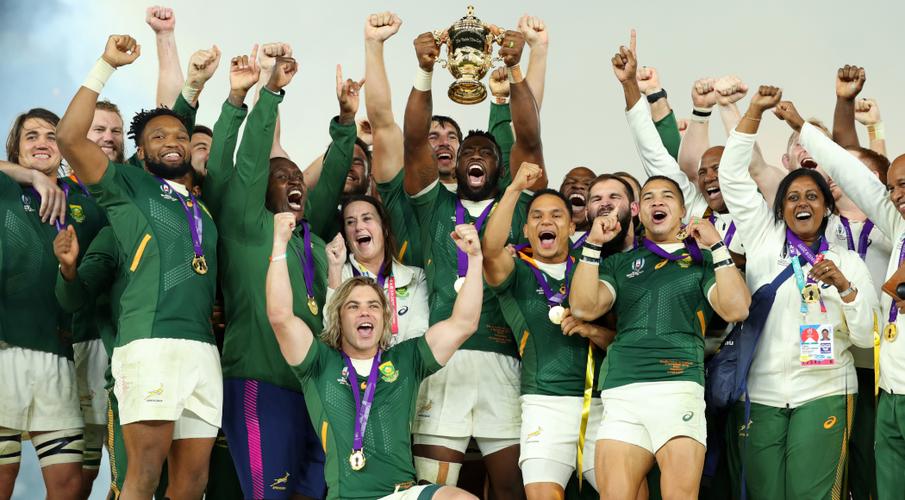
At the World Cup they scored the most
points, the most tries and conceded the least points and the least
tries. When they clinched the World Cup trophy by beating England so
handsomely in the final in Yokohama, they became the first team to win
the Rugby Championship and the Webb Ellis trophy in the same year.
Yes,
let’s not forget that Rugby Championship win – although the competition
was played over just one round this year, the Boks were comprehensive
enough winners of the southern hemisphere version of the Six Nations for
many overseas scribes to install them as World Cup favourites ahead of
the tournament.
Indeed, one of the most bizarre features of the
build-up to the final was how so many of the English scribes and
television pundits who rated South Africa’s chances ahead of the World
Cup wrote them off as no-hopers for the final. It beggared belief, for
the statistics heading into the final, not just from the tournament
itself but from what preceded it, were such that they had to have at the
very least a 50/50 chance of success.
The rugby year started off
for the Boks with Erasmus doing for the opening Championship clash with
Australia in Johannesburg what he had done so often in 2018 – going in
with what looked to most people as a second string selection in a quest
to have a fresh team for the clash with the All Blacks on New Zealand
soil just a week later.
But if it was a gamble it paid off and
Erasmus probably knew the history that reflects that Emirates Airlines
Park is a venue that appears to strike mortal fear into any Wallaby
player. Not that the Australians played particularly poorly that day,
and there were a few opportunities that they wasted in the first half
that, had they been taken, could have turned it into a different game.
The
match though proved the launch board for one of the new players,
scrumhalf Herschel Jantjies, and his two tries, followed up a week later
with the score that secured the draw in Wellington, confirmed depth in a
position where previously Erasmus was struggling.
RIGHT DECISION TO TARGET CHAMPIONSHIP TROPHY
There
were two weeks between the All Black game and the final Championship
test against Argentina, and Erasmus made the right decision in selecting
his best team and going all out for the trophy. Not only did the
decider status given to that game give the Boks another dress rehearsal
opportunity for the World Cup play-off phase, winning a trophy, their
first in the southern hemisphere competition since 2009, increased the
Bok confidence.
The warm-up game organised for two weeks ahead of
the World Cup was another masterstroke on the part of Erasmus and the
SARU management. Not only did it give the Boks the opportunity to get an
early taste of Japanese conditions, it also removed any potential
unknown quantity, and exorcised any ghosts lingering after the infamous
defeat in Brighton in 2015, from the hosts, Japan.
The Boks
weren’t to know it then, but this became particularly useful when they
ended up facing the World Cup hosts in the quarterfinal.
LEARNING FROM MISTAKES
At
the time, everything was being done in preparation for the seismic
World Cup opener against the reigning champions, the All Blacks, in
Yokohama. Erasmus acknowledges he got a few things wrong in the build-up
to that game which he rectified later in the tournament, and had the
All Blacks made it to the World Cup final, the Boks were confident they
would have beaten them.
Certainly for much of that opening game in
Yokohama the Boks showed they had the firepower. They were undone by a
seven minute patch where they appeared to lose concentration, as well as
some rather dubious refereeing calls from Frenchman Jerome Garces, who
was a different animal in the Pool game to the one the Boks encountered
when he refereed their semifinal and the final.
The Boks were
never going to be troubled by any other team in their Pool, but what the
rest of the phase did do was settle a few things for Erasmus, perhaps
the most notable being his decision to place a strong emphasis on
sustained forward power and intensity in every match by going for a
six/two split between forwards and backs on the bench.
It was
against Italy, a game he was worried about just because it was
effectively a knock-out game for his team, that he first tried it, and
the sight of the Bok forwards, with Lood de Jager in the vanguard,
marching the Italians back several metres with their driving mauls will
long linger in the memory.
OVERSEAS CRITICS MISUNDERSTOOD ERASMUS’ METHOD
With
a pack like that of course the Boks were going to rely on it to
overcome Japan in the quarterfinal, and perhaps a lot of overseas
critics misunderstood Erasmus’ method. Even back home the Boks were
being criticised for being one-dimensional, scrumhalf Faf du Plessis for
kicking too much, but they were the tactics required against those
specific opponents.
He was pilloried for his team’s tactics in the
semifinal against Wales in particular, but again he was taking flak for
what was effectively a masterstroke. With so much kicking in the game,
the Welsh defence was never allowed to be a factor in the game, and that
counted positively for the Boks when they had to assess the physical
cost during their short six day turn-around ahead of the final.
THEY FIRED WHEN IT REALLY MATTERED
Had
the Boks been caught up in a physical, bruising semifinal they may not
have been quite as effective as they were when it really mattered – in
the World Cup final at Yokohama’s International Stadium.
And what a
day that was for the Boks and for all of South Africa. England had
shocked the All Blacks a week earlier with the strength of their game
but it didn’t take long for it to become clear that it wouldn’t be the
case against the highly physical Boks.
THE FORWARD BLUDGEON FOLLOWED BY AM WIZARDRY
Although
Bongi Mbonambi and Lood de Jager were both off injured before the game
reached the 20th minute, the damage had already been done by the
juggernaut Bok scrum. With Erasmus bringing in several little
innovations that surprised England, it was quintessential subdue and
penetrate rugby, with the penetration coming through the skill with
which Lukhanyo Am set up Makazole Mapimpi’s try, the first ever try
scored by the Boks in a World Cup final (the late Ruben Kruger did score
one in 1995 but it was disallowed by the referee).
Then just to
rub salt into English wounds up popped Cheslin Kolbe, one of Erasmus’
most inspired selections, to cross for the second try and push the Bok
lead to 20 points, one of the biggest winning margins in a World Cup
final.
It meant that the South African celebrations could start a
good few minutes ahead of the final whistle, and boy did those
celebrations continue into that night in Tokyo and when the Boks arrived
home to complete their trophy tour.
INDIVIDUAL RECOGNITION
Pieter-Steph
du Toit was rightly anointed as the World Player of the Year at the
World Rugby awards ceremony in Tokyo the night after the final, and
Erasmus was confirmed as the Coach of the Year, and in the weeks that
have followed the World Cup all sorts of accolades have been heaped on
the skipper, Siya Kolisi.
It was all a far cry from what would have been expected when Bok rugby was threatening to implode in the latter half of 2016 and into 2017. If there was an administrator of the four year World Cup cycle award given, or an acknowledgement of the best decision made by a rugby boss, the two men who flew to Ireland to speak to Erasmus in 2017 would surely be the leading candidates. The Springbok renaissance started then.
SPRINGBOK RESULTS FROM 2019
South Africa 35 Australia 17
New Zealand 16 South Africa 16
Argentina 13 South Africa 46
South Africa 24 Argentina 18
Japan 7 South Africa 41
South Africa 13 New Zealand 23
South Africa 57 Namibia 3
South Africa 49 Italy 3
South Africa 66 Canada 7
Japan 3 South Africa 26
South Africa 19 Wales 16
South Africa 32 England 12
By Gavin Rich